学术相关
Alex Imas丨What will be scarce? The economics of structural change and the post-commodity future of work
- Scarcity under AI-driven abundance
- If advanced AI brings material abundance, scarcity will not disappear — but the kind of scarcity that matters will change.
- The answer to any question about the future economics of advanced AI begins with identifying what becomes scarce.
- Autor & Thompson: AI reshapes rather than eliminates the value of human expertise
- When automation removes the simpler tasks: the remaining work becomes more specialized, wages rise, and fewer workers qualify.
- When automation removes the harder tasks: the job becomes more accessible, employment expands, and wages fall.
- The starker possibility: AI advances to the point where human expertise loses its economic value altogether → AI eliminates labor scarcity, producing what Herbert Simon called “intolerable abundance.”
- Alex Imas (Author): automation can replicate human production and the commodities it produces, but human labor does not disappear.
- the economics of structural change, combined with deep-seated features of human preferences
- As people get richer, they don’t just want more commodities. They want things that aren’t commodities in the standard sense of the word.
- The more productive, automated sector became a smaller share of the economy despite serving and producing more; the less productive sector (services), whose costs had not fallen — and in fact have risen — became a larger part of the economy.
- Baumol’s cost disease.
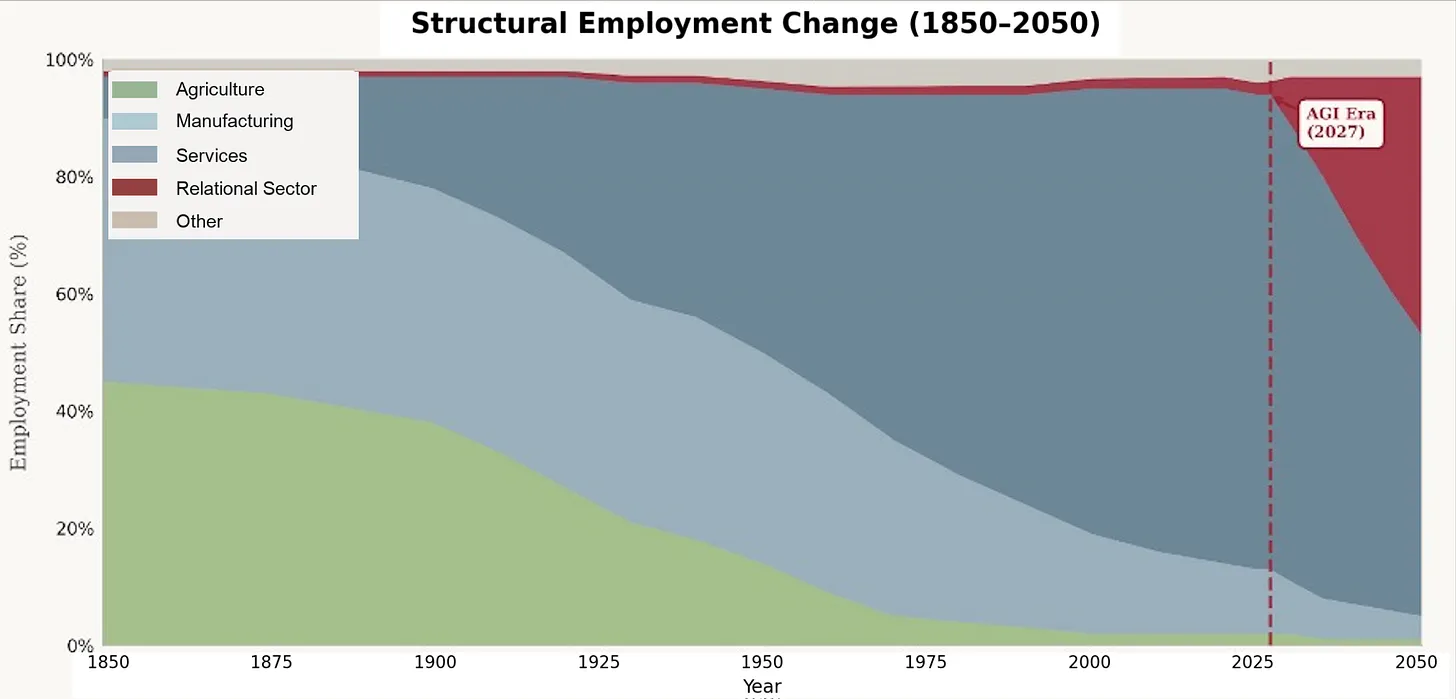
I remain partially skeptical of the author’s claim that expenditure and employment will shift toward the relational sector.
Brief Commentary: A Framework for Detecting AI Agents in Online Research 1
This paper proposes the Cognitive Trap Framework for detecting autonomous AI respondents in online research, achieving 97.1% detection vs. 2.3% for traditional attention checks, with only 4.1% false positives.
I would argue, however, that such traps may be easy to evade from an agent-system development perspective. Even if we accept the author’s defense that the framework sustains itself through continuous trap regeneration, this approach is unlikely to be a valid solution in terms of cost, efficiency, or effectiveness.
-
Affonso, F. M. (2026). Brief commentary: A framework for detecting AI agents in online research. Journal of Consumer Research, 53(3), 619–633. https://doi.org/10.1093/jcr/ucag006 ↩